
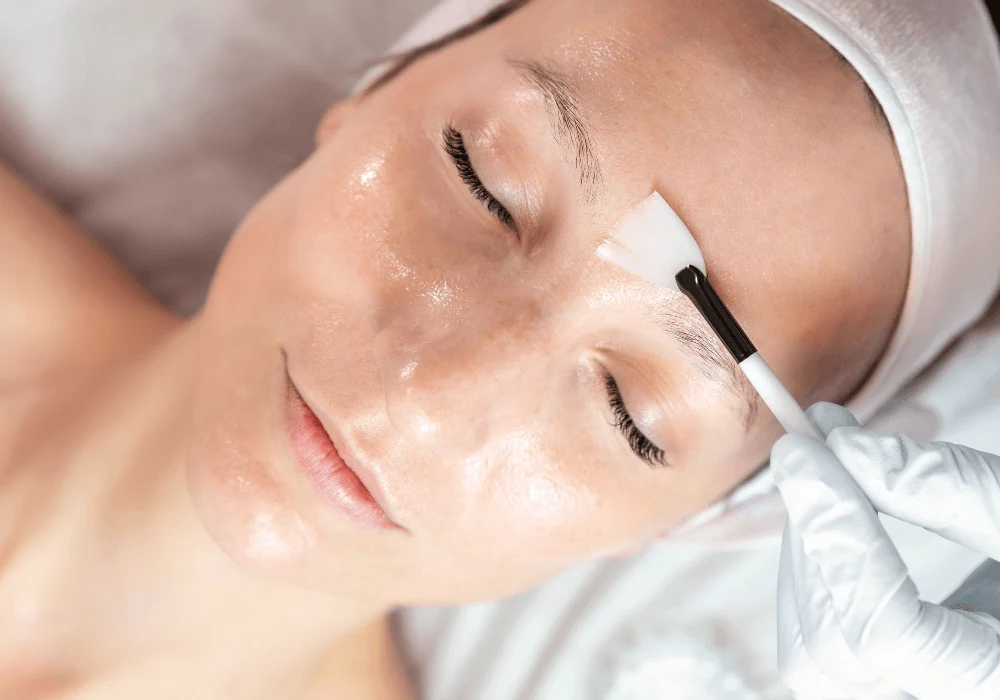
Superficial peel
A superficial peel is a type of chemical peel that creates a controlled chemical exfoliation primarily in the upper layers of the skin. It can be considered for suitable patients dealing with issues such as minor surface texture changes, oiliness, comedones, certain forms of acne, post-acne blemishes, and uneven skin tone.
A superficial peel is not the same procedure as a medium-depth or deep chemical peel. Because the effect is more superficial, the recovery period is typically milder, and many patients are able to return to their daily activities within a short timeframe.
However, the term “superficial” does not imply that the procedure is risk-free or automatically suited for every skin type. The chemical agent used, concentration, product pH, number of application layers, skin phototype, active skin condition, and the state of the skin barrier must be evaluated prior to the procedure.
Determining whether a superficial peel is the right choice should not be driven solely by a “I want to peel my skin” approach. The primary goal is first to properly diagnose the skin problem, and then to select the appropriate procedure for that specific condition.
This article is for informational purposes. Individual diagnosis and treatment plans should be formulated based on a dermatological examination.
What is a superficial peel?
A superficial peel is a chemical peel procedure in which a chemical agent creates a controlled effect primarily within the epidermal layers of the skin.
The epidermis is the outermost layer of the skin. In a superficial peel, the goal is not to cause widespread damage in deeper dermal structures, but rather to influence cell turnover and surface issues in the upper layers of the skin.
For this reason, superficial peels are mostly used for mild and superficial skin alterations.
In contrast, with medium and deep peels, the chemical effect reaches deeper skin layers, thereby increasing the recovery period and the risk of potential complications.
How does a superficial peel affect the skin?
During a superficial peel, the applied chemical agent creates a controlled change among the cells in the upper layer of the skin and can accelerate the shedding of superficial cells.
Following this, the skin renewal process of the epidermis continues.
Depending on the characteristics of the peeling agent used, the procedure may help to:
- Remove superficial dead cells.
- Achieve a more even appearance of uneven texture.
- Reduce follicular congestion.
- Lighten certain superficial pigmentation changes.
- Manage congestion in oily and comedone-prone skin.
The result depends on the type of peel and the depth of the skin issue.
What determines whether a peel is superficial or deeper?
The depth of a peel’s effect is not determined solely by the name of the acid.
The primary factors are:
- The chemical agent used.
- The concentration of the agent.
- The pH level of the product.
- The number of layers applied.
- The contact time with the skin.
- Pre-treatment preparation of the skin.
- The degree of degreasing of the treatment area.
- The condition of the skin barrier.
- The application technique.
- The patient’s individual skin characteristics.
Therefore, the exact same chemical agent can create different penetration depths under different concentrations and protocols.
For example, the penetration depth of glycolic acid can vary based on concentration, application layers, and the duration it remains on the skin.
Which skin problems can be treated with a superficial peel?
Superficial chemical peels are primarily considered for issues located in the upper layers of the skin or where epidermal changes play a role.
Suitable conditions may include:
- Oily skin.
- Comedones.
- Blackheads.
- Closed comedones.
- Certain mild forms of acne.
- Post-acne hyperpigmentation.
- Uneven skin tone.
- Superficial texture changes.
- Dull skin appearance.
- Certain superficial sunspots.
- Mild photoaging.
- Certain cases of melasma.
- Selected superficial actinic changes.
A superficial peel is not an automatic primary treatment for all of these problems.
The exact same-appearing skin spot could be melasma, post-inflammatory hyperpigmentation, or another sun-related pigment change. Treatment selection varies according to the diagnosis.
Can a superficial peel help with acne and comedones?
Certain superficial peeling agents can be used as an adjunct procedure in comedonal and mildly inflammatory acne.
Particularly because of its oil-soluble property, salicylic acid may be chosen when follicular congestion and comedones are prominent.
Glycolic and other superficial peels can also be incorporated into an acne treatment plan in appropriate cases.
However, deep, painful nodules and cystic acne should not be treated with a peel procedure alone. Because this type of acne carries a scar risk, delaying primary dermatological treatment is incorrect.
Detailed information regarding salicylic acid peels should be presented in a separate article.
Does a superficial peel help with acne scars?
A superficial peel can help make certain post-inflammatory hyperpigmentation marks less noticeable.
However, an acne blemish and an acne scar are not the same problem.
A brownish post-acne mark is a pigment change.
A depressed atrophic scar, on the other hand, is a tissue loss created within the skin structure.
A superficial peel may exert a certain effect on pigment appearance, but it does not fill in deep boxcar, rolling, and ice-pick type scars.
For deep scars, subcision, microneedling, radiofrequency, lasers, or other dermatological procedures may be considered depending on the scar structure.
Can a superficial peel be used for melasma?
Superficial chemical peels can be used as an adjunct treatment in certain cases of melasma.
However, melasma is not a simple pigment problem resolved solely by “peeling” the upper layer of the skin.
Sun and visible light exposure, hormonal factors, skin phototype, and inflammatory reactions can influence the course of melasma.
Inappropriate and excessively intensive peeling can increase post-inflammatory hyperpigmentation, especially in dark skin phototypes, causing the spot to appear more prominent.
For this reason, a peel for melasma should not be decided independently, but rather evaluated as part of an overall pigmentation treatment plan.
Which acids are used in superficial peels?
A superficial chemical peel is not the name of a single specific acid.
Various chemical agents and formulas can be used for superficial peeling.
The most commonly encountered include:
- Glycolic acid.
- Salicylic acid.
- Lactic acid.
- Mandelic acid.
- Jessner’s solution.
- Certain low-intensity TCA protocols.
- Other combined superficial peel systems.
The chemical property and primary application area of each agent differ.
Glycolic acid superficial peel
Glycolic acid belongs to the alpha-hydroxy acid (AHA) group.
Due to its small molecular size, its ability to penetrate the skin is high. The intensity of the effect can vary depending on concentration, pH, and application time.
Glycolic acid peels can be used in appropriate cases for:
- Superficial texture changes.
- Dull skin appearance.
- Certain pigmentation problems.
- Mild photoaging.
- Selected acne and post-acne problems.
Determining the safety of a peel simply by looking at the percentage figure of glycolic acid is incorrect. When the pH and application time change at the same concentration, the skin reaction also changes.
Salicylic acid superficial peel
Salicylic acid is an oil-soluble BHA.
Due to this characteristic, it may be one of the more suitable choices when oiliness, comedones, and follicular congestion are at the forefront.
Because a salicylic acid peel is a separate procedural topic, its concentration, role in acne, pregnancy, salicylate sensitivity, and toxicity risk should be explained in detail in a separate article.
Mandelic and lactic acid peels
Mandelic and lactic acids belong to the AHA group.
The molecular size of mandelic acid is larger than that of glycolic acid and penetrates the skin more slowly. This characteristic can allow it to be tolerated more gently in certain sensitive skin types.
Lactic acid, alongside its exfoliating effect, is utilized in various superficial peel formulations for its moisturizing properties.
Which acid is more appropriate should be determined based on the skin problem and sensitivity profile.
Can TCA be used in a superficial peel?
TCA is not an agent used exclusively for medium and deep peels.
In low concentrations and appropriate protocols, TCA can also produce a superficial chemical peel.
As concentration and application technique change, the penetration depth of TCA also changes.
For this reason, the phrase “TCA peel” by itself does not indicate the depth of the procedure.
Unsupervised home use of high-concentration TCA can cause severe chemical burns, pigmentation changes, and scarring.
Who might be a candidate for a superficial peel?
A superficial peel may be considered in appropriate cases for individuals presenting with one or more of the following features:
- Mild unevenness on the skin surface.
- Oiliness.
- Comedones.
- Blackheads.
- Superficial post-acne blemishes.
- Uneven skin tone.
- Mild photoaging.
- Selected pigmentation problems.
- Patients who do not want a long recovery period.
Suitability is not determined solely by the name of the problem.
The health of the skin barrier, phototype, active inflammation, medications used, and prior procedures must also be taken into consideration.
Can a superficial peel be performed on dark skin phototypes?
Certain superficial chemical peels can also be used in darker skin phototypes, such as Fitzpatrick IV–VI.
Because superficial peels penetrate more limitedly than medium and deep peels, they represent the category of chemical peels most frequently utilized in darker phototypes.
Nevertheless, the risk of post-inflammatory hyperpigmentation (PIH) must be separately evaluated in dark skin phototypes.
Particular considerations include:
- Previous history of PIH.
- Melasma.
- Active irritation.
- Condition of the skin barrier.
- Peeling agent.
- Intensity of the procedure.
- Parallel active skincare products.
- Ability to practice sun protection.
A stronger peel in a dark phototype does not automatically mean a better result.
A controlled and more conservative approach may be more appropriate for certain patients.
In whom might a superficial peel be postponed?
In the following situations, postponing the procedure or conducting additional medical evaluation may be necessary:
- Active bacterial skin infection.
- Active herpes.
- Fungal infection.
- Open wound.
- Recent sunburning.
- Active eczema.
- Active dermatitis.
- Severe rosacea flare-up.
- Severely damaged skin barrier.
- Intense dryness and cracking.
- Recent history of another chemical peel.
- Recent laser or other intensive procedure.
- History of problematic wound healing.
- Known sensitivity to the acid being used.
- Use of medications and actives that could interact with the procedure.
Decisions during pregnancy and lactation must be made separately depending on the specific chemical agent to be used. It is incorrect to group all superficial peeling acids into the same safety category.
What should be considered before a superficial peel?
Properly identifying the primary skin problem prior to the procedure is essential.
The dermatologist should be informed of the following information:
- Skincare products currently in use.
- Retinol, tretinoin, and other retinoids.
- Products containing AHAs and BHAs.
- Benzoyl peroxide.
- Oral and topical medications used for acne.
- Previous chemical peels.
- Previous laser procedures.
- History of herpes.
- History of allergies and sensitivities.
- Pregnancy and lactation.
- Recent sun exposure and sunburn.
- Persistent burning and flaking in the skin barrier.
Preparations prescribed by a physician should not be stopped arbitrarily.
The timeline for stopping retinoids and other active products prior to the procedure should be determined based on the specific peel system and skin condition.
How is a superficial peel procedure performed?
The exact protocol of a superficial peel varies depending on the chemical agent used.
General steps may include:
- The final condition of the skin is evaluated.
- The treatment area is cleaned.
- When necessary, the skin surface is degreased.
- Eyes, lips, and other sensitive areas are protected.
- The peel solution is applied in a controlled manner.
- Clinical skin reaction is monitored.
- Application is completed in accordance with the product protocol.
- Neutralization is performed when necessary.
- Soothing care is applied.
- Home care instructions are explained.
Not all peeling acids are neutralized using the same method.
Therefore, application and neutralization rules used for one acid cannot be applied to another peeling product.
Is a superficial peel painful?
Sensations of stinging, warmth, prickling, and tightness may occur during the procedure.
The intensity of the sensation varies depending on the chemical agent used, concentration, pH, contact time, and skin sensitivity.
Strong and rapidly increasing pain, intensive burning, and acute swelling should not be considered normal reactions.
In such a situation, the specialist performing the procedure must be notified immediately.
How should the skin be cared for after a superficial peel?
The primary objective after a superficial peel is to allow the skin barrier to recover and to prevent additional irritation.
General care guidelines may include:
- Using a gentle cleanser.
- Applying an appropriate skin moisturizer.
- Using a broad-spectrum sunscreen.
- Avoiding rubbing the skin.
- Not picking at flakes or peeling skin.
- Not attempting to mechanically peel the skin.
- Not starting new active products.
- Not arbitrarily returning to strong acids and retinoids.
- Protecting against direct sunlight as much as possible.
- Staying away from tanning beds.
Allowing the skin to avoid dryness and cracking is important during the healing process.
What should be avoided in the first few days?
Activities that excessively heat and irritate the skin can be temporarily restricted during the first few days.
These may include:
- Very hot showers.
- Saunas.
- Steam.
- Heavy workouts.
- Scrubs.
- Skin brushes.
- Retinoids.
- AHA and BHA products.
- Strong acne actives.
- Picking and squeezing the skin.
When the skin reaction is mild, a return to daily activities can happen more quickly.
What is the recovery period after a superficial peel?
A superficial peel has the shortest recovery period among all chemical peel categories.
According to the American Academy of Dermatology, the primary healing time after a light or “lunchtime” peel can range from approximately 1 to 7 days.
In the initial stage, mild redness may occur.
In the following days, fine flaking may appear in some patients, and this process can last for several days.
In other patients, visible peeling is very minimal or hardly noticeable.
The absence of visible flaking does not mean the procedure was ineffective.
When can one return to work and daily life?
Following many superficial peels, it is possible to resume daily activities on the same day or the next day.
However, skin appearance can vary individually.
Social discomfort may persist for a few days in individuals experiencing redness, dryness, and noticeable flaking.
If a wedding, photo shoot, or important event is planned, scheduling a first-time peel immediately prior to the event is not advisable.
When are results visible after a superficial peel?
Initial changes may be visible once the skin calms down.
Some patients may notice that their skin appears:
- Smoother.
- Brighter.
- Less oily.
- More even in texture.
For issues like pigmentation, comedones, and acne, results often require more than a single procedure.
Evaluating results solely by how much the skin peels is incorrect.
How many sessions does a superficial peel require?
There is no universal number of sessions.
The American Academy of Dermatology patient guide notes that for mild chemical peels, some patients may require 3 to 5 procedures to achieve the desired result, and sessions can be repeated at intervals of approximately 2 to 5 weeks.
These figures do not represent a standard protocol for all peeling agents and all patients.
Session counts are influenced by:
- The skin problem.
- The peeling agent.
- Intensity of the procedure.
- Skin phototype.
- Previous skin reaction.
- Parallel dermatological treatment.
- Home care.
- Sun protection.
In cases where the skin is heavily irritated, it is often more appropriate to wait for complete skin recovery rather than following a predetermined calendar for the next session.
What are the risks and side effects of a superficial peel?
Although a superficial peel is milder than other chemical peel categories, it is not entirely risk-free.
Expected mild reactions include:
- Redness.
- Stinging.
- Tightness.
- Dryness.
- Sensitivity.
- Fine flaking.
Possible complications include:
- Prolonged redness.
- Chemical burn.
- Blistering.
- Post-inflammatory hyperpigmentation.
- Hypopigmentation.
- Activation of herpes.
- Bacterial infection.
- Delayed healing.
- Rare cases of scarring.
Risks can increase with inappropriately high concentrations, prolonged contact times, damage to the skin barrier, and incorrect post-procedure care.
The U.S. FDA warns that the unsupervised home use of high-concentration peeling products such as glycolic, salicylic, lactic acid, and TCA can cause severe chemical burns, infections, color changes, and scarring.
Under what symptoms should one contact a dermatologist?
The following symptoms may exceed a normal mild peel reaction:
- Progressively increasing pain.
- Severe swelling.
- Widespread blistering.
- Open wound.
- Purulent discharge.
- Foul odor.
- Fever.
- Herpes-like blisters.
- Rapid darkening of the skin.
- Noticeable discoloration of the skin.
- Skin reactions that worsen instead of healing.
In these situations, instead of using new products arbitrarily, a medical evaluation must be conducted.
What is the difference between a superficial peel and a medium-depth peel?
The primary difference between a superficial and a medium-depth peel is the depth of penetration of the controlled chemical effect into the skin.
A superficial peel primarily acts at the epidermal level.
A medium-depth peel, however, can reach deeper layers, down to the papillary dermis and, in selected protocols, the upper reticular dermis level.
Consequently, a medium-depth peel may require:
- A longer recovery period.
- More noticeable flaking.
- More intensive wound care.
- A higher risk of pigmentation.
- More rigorous patient selection.
A deeper peel is not automatically a better peel.
Choosing a more intensive procedure when a problem is superficial creates unnecessary recovery and complication burdens.
Superficial peel procedures in Baku
For an individual considering a superficial peel in Baku, the first step is not choosing an acid name.
The underlying skin problem must first be identified.
For example, a brown spot could be:
- Post-acne hyperpigmentation.
- Melasma.
- Solar lentigo.
- Another pigmentation problem.
During the initial consultation, the skin problem, phototype, active inflammation, preparations used, skin barrier, pigmentation risk, and appropriate peel type can be evaluated together.
To determine whether a superficial peel is suitable for your skin, you may consult dermatologist Dr. Rəşad İsayev.
Frequently asked questions about superficial peels
Does the skin necessarily peel after a superficial peel?
No. Some patients experience fine flaking, while in others, visible peeling may be minimal or non-existent. The amount of peeling alone does not indicate the effectiveness of the procedure.
Is a superficial peel painful?
Mild to moderate stinging, warmth, and prickling sensations can occur. Strong and progressively increasing pain is not considered a normal reaction.
How many days of recovery are needed after a superficial peel?
The main recovery period often varies between roughly 1 to 7 days. The exact duration depends on the peeling agent used and the skin’s reaction.
Does a superficial peel help with blackheads?
Certain superficial peeling agents, particularly salicylic acid, can help reduce comedones and follicular congestion. However, the result may not be permanent, and new comedones can form.
Does a superficial peel eliminate acne scars?
It does not eliminate deep acne scars. It can exert a certain effect on surface texture and pigment changes, but deep atrophic scars require other procedures.
Can a superficial peel be performed on a dark skin phototype?
Certain superficial peels can be used in dark skin phototypes. However, due to the risk of post-inflammatory hyperpigmentation, the peeling agent and intensity must be chosen carefully.
Can a high-percentage superficial peel be done at home?
The unsupervised home use of high-concentration professional peeling products is dangerous. It can cause chemical burns, infections, pigmentation changes, and scarring.
Sources
- American Academy of Dermatology. Chemical Peels: FAQs. Patient information regarding 1–7 day recovery times, home care, and potential side effects after superficial chemical peels.
- DermNet NZ. Chemical Peels. Classification, indications, and risks by skin phototypes for superficial, medium, and deep chemical peels.
- Berson DS et al. Clinical Role and Application of Superficial Chemical Peels in Today’s Practice. Journal of Drugs in Dermatology. 2009. PMID: 19746672.
- Landau M. Chemical Peels. Clinics in Dermatology. Superficial chemical peels review. PMID: 17177748.
- Dayal S et al. Basic Chemical Peeling: Superficial and Medium-Depth Peels. Journal of the American Academy of Dermatology. 2019. PMID: 30550830.
- U.S. Food and Drug Administration. FDA Warns Against Purchasing or Using Chemical Peel Skin Products Without Professional Supervision. July 30, 2024.