
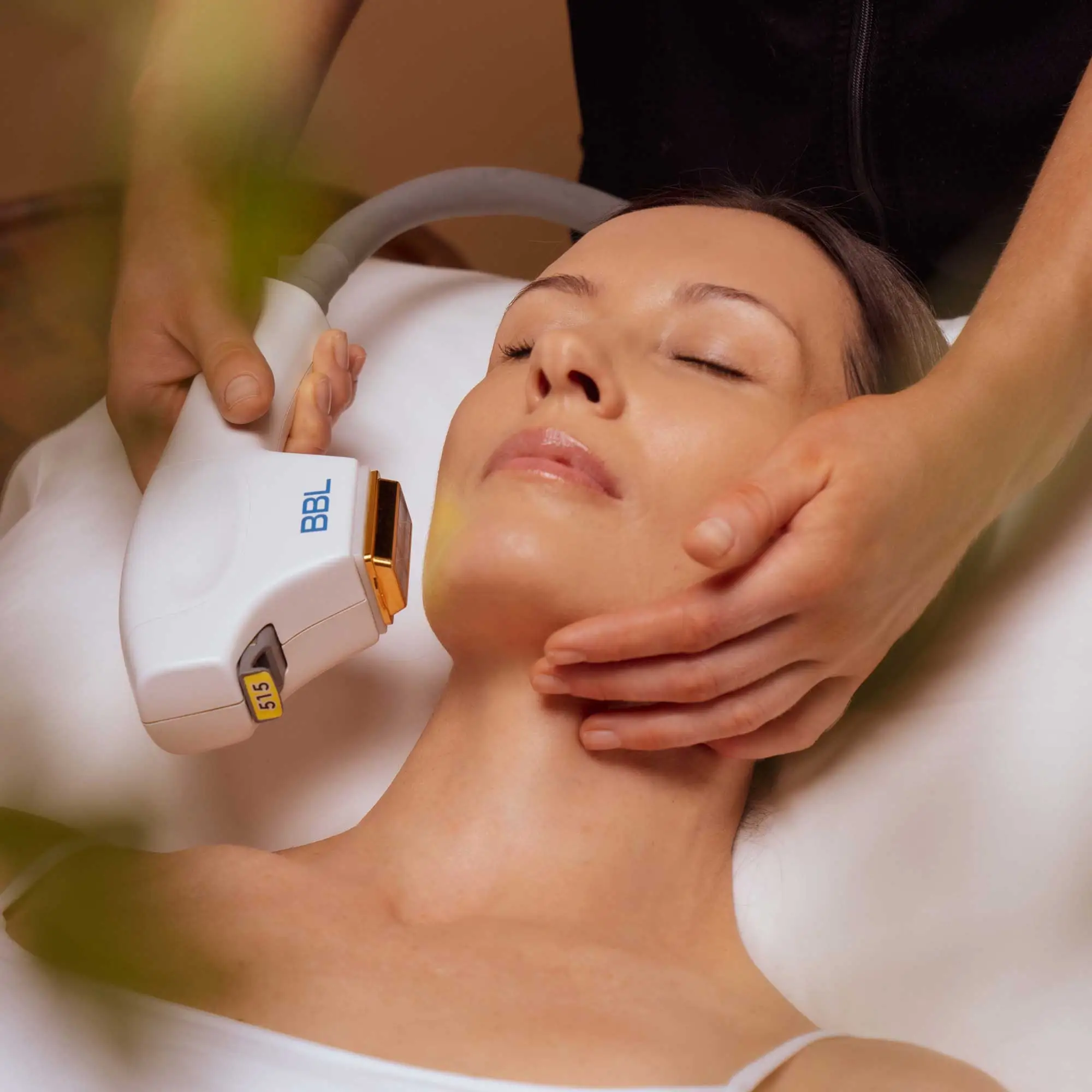
BroadBand Light (BBL)
BroadBand Light (BBL) is a light-based procedure used to reduce the appearance of blemishes, redness, capillary vessels, and sun damage on the skin.
What is BroadBand Light (BBL)?
BroadBand Light (BBL) is a light-based procedure used for skin concerns such as blemishes, redness, vascular appearance, and sun damage. Patients often search for this procedure as “BBL laser.” In reality, BBL is not a classic laser, but a phototherapy technology that operates with broad-spectrum light energy.
The purpose of BBL is not to deeply exfoliate the skin. The procedure targets pigmentation and vascular appearance in the skin using light energy. Therefore, it can be considered after a dermatologist examination in cases such as sunspots, redness, uneven skin tone, and photodamage. Unlike lasers, IPL technologies emit broad-spectrum, polychromatic light and can be used for different skin concerns with various filter/energy parameters.
Is BBL considered a laser?
BBL is often known as “BBL laser,” but technically it is not a classic laser. A laser typically operates with a narrower and specific wavelength. BroadBand Light, on the other hand, utilizes broad-spectrum light energy.
The main difference for the patient is this: BBL does not aim to create deep peeling similar to ablative lasers such as Fractional CO₂ and Er:YAG. It is used more to exert a targeted effect with light energy on concerns like blemishes, redness, vascular appearance, and sun damage.
How does BroadBand Light (BBL) work?
During BBL, controlled light pulses are applied to the skin. This light energy primarily targets two components in the skin: melanin and hemoglobin.
Melanin is the pigment that gives color to the skin. Sunspots, certain brown spots, and pigment irregularities can be related to melanin. Hemoglobin, on the other hand, is associated with blood vessels. Hemoglobin is one of the main targets in redness, capillary vessel appearance, and certain vascular-based color changes.
To put it simply:
| Target in the skin | What is it related to? | What can BBL do? |
| Melanin | Sunspot, brown pigment | Can help reduce the appearance of blemishes |
| Hemoglobin | Redness, capillary vessel appearance | Can soften redness and vascular appearance |
| Skin tone | Uneven color | Can help the skin look more even |
| Sun damage | Dullness, tone difference, blemish | Can create a more vibrant appearance |
For which concerns is BroadBand Light (BBL) used?
BBL is mostly preferred for sunspots, redness, vascular appearance, uneven skin tone, and signs of photoaging. However, not every blemish and every redness is suitable for BBL. First, the underlying cause of the concern must be clarified.
Sunspots and photodamage
Sun damage can cause brown spots, dullness, and tone differences on the skin. BBL can help reduce the appearance of such superficial blemishes. The result depends on the type of blemish, skin color, sun protection, and the session plan.
Redness and capillary vessel appearance
BBL can be considered for diffuse redness, capillary vessel appearance, and certain vascular-based redness. However, if rosacea and active inflammatory redness are present, a dermatologist evaluation is required first.
Skin tone unevenness
BBL can help improve skin tone, but the cause of the tone difference must first be evaluated by a dermatologist.
Photoaging and dull skin appearance
Sun exposure, age, stress, and improper care can make the skin look dull. BBL can help the skin look more even and vibrant in some patients. However, claims such as “it completely rejuvenates the skin” or “it stops aging” are not true.
Acne-prone skin
In some cases, BBL can be part of a combined approach for acne-prone skin. However, if active, purulent, and painful acne is present, the acne must first be brought under control by a dermatologist. It is noted that the evidence regarding the efficacy of IPL in acne treatment is contradictory, and risks such as erythema, blistering, crusting, pigment changes, and infection can be among the side effects.
BBL may be suitable for you if:
- You are bothered by sunspots;
- Your skin tone appears uneven;
- You have redness and capillary vessel appearance;
- You want a more vibrant and clean skin appearance;
- You are looking for a non-invasive procedure;
- You want a lighter recovery period;
- You will be able to strictly follow SPF use after the procedure.If melasma, active tanning, sunburn, a dark skin type, or a high risk of hyperpigmentation is present, BBL should be planned only after a dermatologist evaluation.
For whom is BroadBand Light (BBL) not suitable?
BBL is not a suitable procedure for every patient. In the following cases, the procedure may be postponed or discussed only by a doctor’s decision:
- Active sunburn;
- Recent tanning;
- Solarium use;
- Active skin infection;
- Open wound and irritated skin;
- Active herpes;
- Photosensitive medication use;
- Certain diseases that cause sensitivity to light;
- Melasma and high risk of hyperpigmentation;
- Risk of pigment change in dark skin types;
- Pregnancy and lactation period;
- Patients who will not use SPF after the procedure;
- Unrealistic expectation of results.During pregnancy and the lactation period, such elective aesthetic procedures are usually postponed. The procedure can be discussed only with a doctor’s evaluation.
Can BBL be performed during pregnancy and lactation?
During pregnancy and the lactation period, elective aesthetic procedures like BBL are usually postponed. The procedure should be discussed only with a doctor’s evaluation.
What is the risk of BBL in dark skin types?
The topic of BBL in dark skin types requires special attention. This does not mean that BBL can never be performed on dark skin. However, the risk can be higher, and the procedure must be planned more cautiously.
Why is BBL risky for tanned skin?
Tanning means increased melanin activity in the skin. BBL, on the other hand, works with color targets such as melanin and vessels. If the skin is tanned, the light energy may target not only the blemish but also the surrounding healthy skin to a greater extent.
Can BroadBand Light (BBL) be used in melasma?
Melasma is not an ordinary sunspot. It is a pigment problem that tends to recur and is related to sun, heat, hormonal changes, and genetic predisposition. Therefore, BBL should not be presented as the first choice in melasma.
The main approach in melasma is usually strict sun protection, appropriate topical treatment, and dermatologist supervision. BBL can be considered only if the skin doctor deems it appropriate, with a very cautious parameter selection.
Is the BBL procedure worth having done?
BBL is evaluated more for patients with blemishes, redness, vascular appearance, and sun damage. If the goal is not to peel the skin but to show the skin tone more even and vibrant, BBL can be one of the appropriate options.
This procedure can be valuable for you if you are ready for a few sessions, will follow the SPF regimen, and have realistic expectations of the result.
However, if you expect a complete result in a single session, if you have plans for the beach and active sun in the coming days, if your melasma is active, or if you will not use SPF, it is safer to postpone the procedure.
How should the preparation before the procedure be?
It would not be an exaggeration to say that preparation before BBL is half the result. Because if the skin is not ready for the procedure, even the best device may not yield the desired result.
First, a dermatologist or the physician performing the procedure must evaluate the skin. Here, simply saying “there is a blemish” is not enough. The cause of the blemish, skin color, tanning history, medications used, and home care should be considered together.
Key points to check before BBL:
- Skin type;
- Type of blemish;
- Cause of redness;
- Possibility of melasma;
- Sun exposure in recent weeks;
- Whether tanning has occurred;
- Solarium use;
- Photosensitive medications;
- Herpes history;
- Active skin infection;
- Open wound and irritation;
- Use of retinol, acids, and active products;
- SPF usage habit.If the patient will not protect themselves from the sun after the procedure, planning BBL would not be correct. This may sound harsh, but it is essential for patient safety.
What should be considered before BBL?
The skin must be evaluated correctly before BBL. The doctor usually looks at:
- Skin type;
- Cause of the blemish and redness;
- Possibility of melasma;
- Tanning and sunburn;
- Medications used;
- History of photosensitivity;
- History of herpes;
- Previous laser, IPL, and peeling procedures;
- Whether you will comply with SPF use;
- Your expectation from the result.Before the procedure, it is necessary to stay away from sunbathing and solariums. If there is tanning or sunburn, the procedure must be postponed. Retinol, AHA/BHA, and irritating products can be discontinued upon a doctor’s instruction.
How is the BroadBand Light (BBL) procedure performed?
The procedure must be performed in clinical conditions. First, the skin is cleansed, and the target concern and skin type are re-evaluated. Then, eye protection is put on, device parameters are selected, and light pulses are applied to the area progressively.
During the procedure, there may be discomfort similar to a mild stinging, heat, and the feeling of being snapped by a rubber band. It is not correct to say “it is completely painless.” In many patients, the discomfort felt is tolerable, but this varies individually.
Eye protection is mandatory. Since BBL/IPL type devices operate with powerful light pulses, the procedure must not be performed without eye protectors.
Recovery period after BroadBand Light (BBL)
Recovery after BBL is usually not heavy. However, redness, heat, sensitivity, mild swelling, and darkening of the blemishes may appear after the procedure.
Within the first 24 hours, it is safer to stay away from hot showers, saunas, steam, active sports, and the sun. The skin must not be rubbed, scratched, or irritated.
If blemishes were targeted, they may initially appear darker. In the following days, these areas may begin to lighten by flaking mildly. At this stage, the crusts must not be picked, as the risk of blemishes and scars may increase.
Why is sun protection so important?
Sun protection after BBL directly affects the result. UV rays increase the risk of blemishes, color changes, and irritation.
A broad-spectrum sunscreen of SPF 30 or higher must be used after the procedure. The sunscreen should be renewed during the day, hats and glasses should be used, and solariums and active sun should be avoided.
This is particularly important in the climate of Azerbaijan. During the summer months, the risk of beach, open air, and tanning increases the likelihood of post-BBL hyperpigmentation.
Can BroadBand Light (BBL) be performed in summer?
It can be performed in summer, but it is not suitable for every patient. If the skin is tanned, if there is sunburn, if there is a beach plan in the coming days, or if SPF use will not be complied with, it is safer to postpone the procedure.
In summer, BBL can be considered only in patients who can strictly protect themselves from the sun, are not tanned, and are deemed suitable by a dermatologist.
Quick answers about BroadBand Light (BBL)
| Question | Short answer |
| Is it painful? | There may be a feeling of stinging, heat, and mild pinching. |
| Can it cause blemishes? | Tanning, melasma, dark skin type, and poor SPF use increase the risk. |
| How many days does redness last? | It usually decreases within a few days, but it varies individually. |
| Can one go to work? | Many patients can return to daily life quickly. |
| When is the result visible? | Blemishes may first darken and begin to lighten within 7–14 days. |
| How many sessions are needed? | It varies according to the concern; the exact plan is determined during the consultation. |
How many sessions does BroadBand Light (BBL) require?
There is no single number of sessions suitable for everyone for BBL. The number of sessions varies according to the type of concern, skin type, depth of the blemish, cause of the redness, and the protocol used.
| Concern | Session approach |
| Sunspots | A few sessions may be needed |
| Redness and vascular appearance | May require a progressive plan |
| Photoaging | An individual protocol is selected |
| Skin tone unevenness | Varies depending on the cause |
| Melasma | A very cautious approach is required |
| Dark or tanned skin | Risk must be evaluated first |
The exact number of sessions is determined during the dermatologist consultation. It is not correct to give a guaranteed result in advance.
When does the result appear?
The result depends on the purpose of the procedure. If a blemish is targeted, the pigment may first darken and then begin to lighten. The change in redness and vascular appearance occurs more progressively.
| Period | What can happen? |
| First hours | Redness, heat, sensitivity |
| 1–3 days | Darkening of the pigment, mild swelling |
| 7–14 days | Lightening and flaking of dark blemishes |
| After a few sessions | A clearer change in skin tone |
The permanence of the result highly depends on SPF use, staying away from tanning, and proper home care.
Possible risks and side effects of the BroadBand Light (BBL) procedure
BBL can be beneficial with proper patient selection and professional application. However, it is not a risk-free procedure.
Possible side effects:
- Redness;
- Sensation of heat;
- Stinging and pain;
- Swelling;
- Flaking;
- Blistering;
- Hyperpigmentation;
- Hypopigmentation;
- Burn;
- Infection;
- Rarely, scarring;
- Risk of eye injury.Most of the risks can be reduced with proper patient selection, appropriate parameters, eye protection, and post-procedure care. However, they cannot be completely eliminated.
How to reduce risks?
The most important step to reduce risks is proper patient selection and correct parameter selection. The procedure must be performed under the supervision of a dermatologist or a qualified medical aesthetician. BBL should not be performed on tanned skin, the risk of melasma should be evaluated separately, photosensitive medications must be reported to the doctor, and eye protectors must strictly be used.
After the procedure, SPF must be applied rigorously, crusts must not be picked, and if suspicious symptoms occur, the doctor should be contacted.
When should a doctor be consulted after the procedure?
Mild redness, heat, and sensitivity may occur after BBL. However, if pain increases, if severe burning, extensive blistering, purulent discharge, foul odor, rapidly spreading redness, eye pain, vision discomfort, or a rapid increase in blemishes occurs, a doctor must be consulted without waiting.
BroadBand Light (BBL) price Baku 2026
The price of BBL in Baku is not fixed. The price can vary according to the treated area, the type of concern, the number of sessions, the device system, the doctor’s experience, and the clinic’s protocol.
| Factor | Effect on price |
| Treated area | Areas such as face, neck, décolleté, and back of the hands may be priced differently |
| Type of concern | Blemishes, redness, vascular appearance, and photodamage may require different protocols |
| Number of sessions | When a few sessions are needed, the total cost changes |
| Device and filter selection | The technology and protocol used can affect the price |
| Doctor’s experience | An experienced dermatologist and clinical approach can play a role in the price |
| Post-care | SPF and restorative products can create additional costs |
BBL prices across Baku are determined during the dermatologist consultation according to the skin condition, the area to be treated, the type of concern, and the required number of sessions.
How does BroadBand Light (BBL) differ from other procedures?
BroadBand Light (BBL) is not a laser, but a broad-spectrum light-based phototherapy procedure. While laser systems typically operate with a specific wavelength, BBL can be applied in a targeted manner toward concerns such as pigment changes, redness, and visible fine vessels through various light parameters. Chemical peeling, on the other hand, creates exfoliation in the upper layer of the skin through acids rather than light energy. For this reason, BBL can be considered more in cases such as superficial sunspots, signs of aging caused by the sun, skin tone unevenness, and redness. Which procedure is more suitable is determined based on skin type, the character of the blemish, pigmentation risk, and the clinical evaluation of the dermatologist.
BBL and IPL difference
BBL is a broad-spectrum light technology and can be explained as a brand/protocol-based phototherapy approach close to the IPL family. The difference depends on the device system, filter selection, energy management, cooling mechanism, and clinical protocol.
| BBL | IPL |
| Can be explained as a brand/protocol-based light technology close to the IPL family | Is a general term for broad-spectrum light systems |
| Filter, energy, and cooling management can differ depending on the device system | Parameter capabilities vary from device to device |
| Can be used in blemishes, redness, and photodamage | Can be used for similar purposes |
| The result depends on the device, protocol, and doctor’s experience | The result depends on the device, protocol, and doctor’s experience |
BBL and Q-switched Nd:YAG laser
Q-switched Nd:YAG is mostly used in tattoos and certain deep/dark pigment concerns. BBL, on the other hand, can be considered more in photoaging, superficial blemishes, redness, and vascular appearance.
BBL and Er:YAG laser
Er:YAG is an ablative resurfacing procedure and is used to renew the surface of the skin. BBL, on the other hand, exerts a light-based phototherapy effect without creating deep peeling in the skin.
BBL and Chemical peeling
Chemical peeling creates chemical exfoliation in the skin. BBL, on the other hand, targets pigment and redness with light energy. Which approach is suitable is determined according to the cause of the concern and the skin type.
Frequently asked questions
Is BroadBand Light (BBL) safe?
BroadBand Light (BBL) can be a beneficial and relatively safe approach when performed with proper patient selection, appropriate parameters, eye protection, professional application, and strict SPF use after the procedure.
However, there is a risk of redness, swelling, blemishes, blistering, burns, hyperpigmentation, hypopigmentation, and rare scarring. Therefore, a dermatologist examination before the procedure is essential.
Is BBL considered a laser?
No. Technically, BBL is not a classic laser. BBL is a phototherapy technology that operates with broad-spectrum light energy.
Which blemishes can BBL help with?
It can help reduce the appearance of sunspots and certain superficial pigment concerns. In melasma, however, a very cautious approach is required.
Does BBL help with redness?
It can soften the appearance in some cases of vascular-based redness and diffuse redness. If rosacea is present, a dermatologist evaluation is needed first.
Is BBL dangerous in melasma?
BBL should not be presented as the first choice in melasma. Melasma is a pigment concern that can be activated by heat, sun, and light. Therefore, BBL can be considered only if the dermatologist deems it appropriate and the risks are clearly explained to the patient.
Can BBL be performed on dark skin types?
It can be performed on dark skin types, but the risk of blemishes and burns is higher. Therefore, suitability must be evaluated separately by a dermatologist.
Can BBL be performed in summer?
In summer, it can be considered only in patients who can strictly protect themselves from the sun, are not tanned, and do not have sunburn. If there is a beach and active sun plan, it is safer to postpone the procedure.
Why do blemishes darken after BBL?
When pigment is targeted, blemishes may initially darken. Then, those areas may gradually flake and begin to lighten.
Is a home IPL device the same as clinical BBL?
No. Home IPL devices and the clinical BBL system are not the same. In the clinical protocol, energy, filter selection, skin reaction, and safety are managed by a specialist.
Conclusion
BroadBand Light (BBL) is a light-based phototherapy procedure used for blemishes, redness, vascular appearance, sun damage, and photorejuvenation. In a properly selected patient, it can help the skin tone look more even, cleaner, and more vibrant.
However, this procedure is not a simple cosmetic care. Skin type, tanning, melasma risk, tendency to hyperpigmentation, photosensitive medication use, and SPF discipline must absolutely be evaluated.
To find out whether the BBL procedure is suitable for your skin, sign up for a dermatologist consultation.