
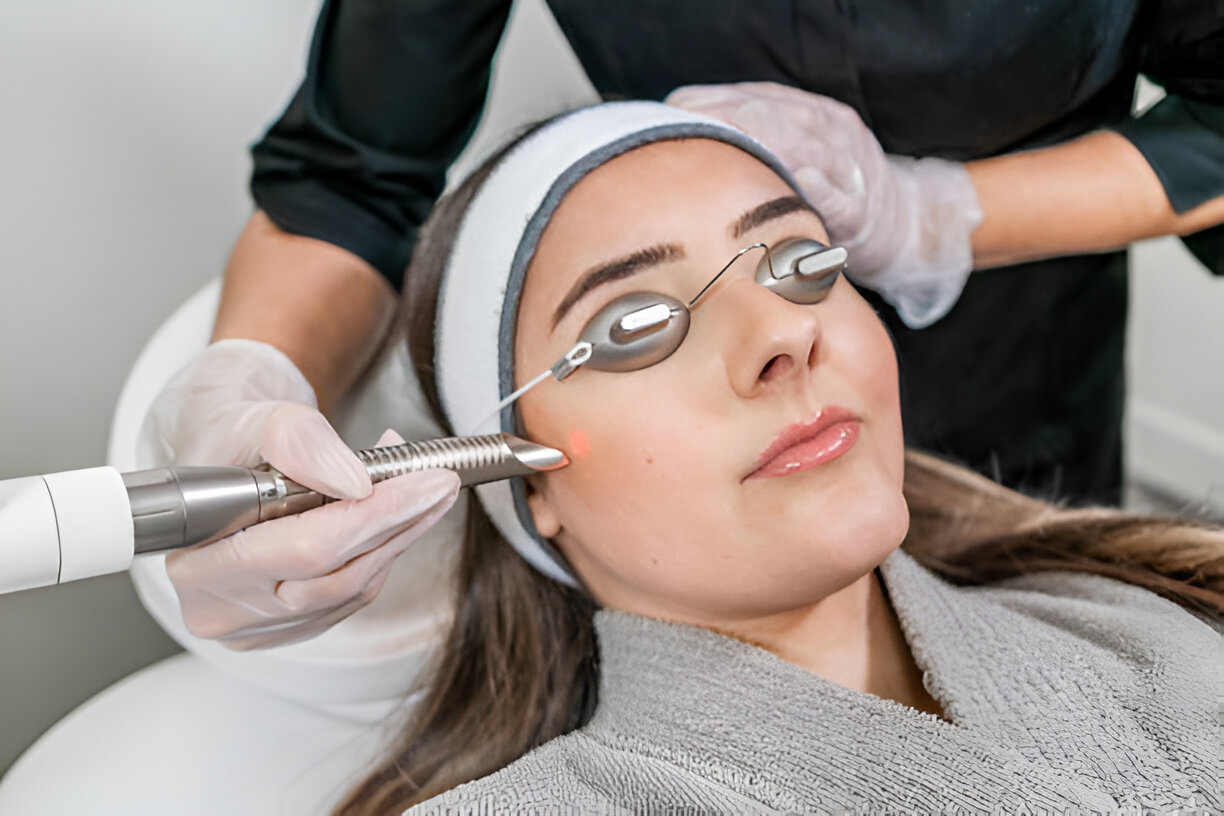
Er:YAG laser
The Er:YAG laser is an ablative laser technology operating at a wavelength of 2940 nm. Because its energy is strongly absorbed by the water in the skin, it allows for the controlled ablation of the epidermis and selected superficial dermal tissue. In dermatology, it can be used in the treatment of photoaging, uneven skin texture, superficial wrinkles, and certain scars.
Er:YAG is not the name of a single procedure. The same 2940 nm laser can be applied in fully ablative or fractional modes. The area of effect, recovery time, and risk profile of these two approaches are not the same.
A fully ablative Er:YAG treats the entire surface of the selected skin area. A fractional Er:YAG, on the other hand, creates microscopic treatment zones and leaves unaffected tissue between them. Therefore, questions like “How many days does an Er:YAG laser take to heal?” and “How many sessions are needed?” do not have the same answer for everyone.
What is the Er:YAG laser?
Er:YAG is an erbium-doped yttrium-aluminum-garnet laser system. It generates energy at a wavelength of 2940 nm for dermatological skin resurfacing. Since this energy is strongly absorbed by water, the effect is primarily concentrated in the water-rich epidermal and dermal tissue.
The goal of the Er:YAG laser is not simply to “peel” the skin. Selected superficial tissue is removed through controlled ablation, after which re-epithelialization—that is, the resurfacing of the skin with epithelial cells—begins. The healing process may be accompanied by a certain degree of dermal collagen remodeling.
The effect of the procedure is influenced by the following:
- Fractional or fully ablative application;
- Energy density;
- Pulse duration;
- Number of passes;
- Ablation depth;
- Treatment area;
- Skin phototype;
- Underlying skin problem;
- Post-procedure care.
How does the Er:YAG laser work on the skin?
The 2940 nm laser energy is rapidly absorbed by the water in the skin. When sufficient energy is delivered, the water in the targeted tissue heats up rapidly, and a very thin layer of tissue is vaporized and removed.
This characteristic allows the Er:YAG laser to perform precise ablation. Compared to the classic CO₂ laser, thermal coagulation in the surrounding tissue is typically more limited.
This does not mean that the Er:YAG laser creates no thermal effect. In modern systems, additional thermal effects can be achieved by modifying the pulse duration and device mode.
| Effect | Possible Clinical Outcome |
| Controlled epidermal ablation | Skin surface resurfacing |
| Superficial dermal effect | Texture improvement |
| Healing response | Collagen remodeling |
| Scar surface resurfacing | Less noticeable scars |
| Removal of photodamaged surface | More even skin appearance |
What is the difference between fractional and fully ablative Er:YAG laser?
The main difference is how much of the skin is ablated in the same session. A fully ablative Er:YAG treats the selected area entirely. A fractional Er:YAG creates microscopic treatment columns, leaving unaffected skin between them.
| Feature | Fully Ablative Er:YAG | Fractional Er:YAG |
| Treatment model | Entire area | Microzones |
| Epidermal ablation | Entire area | Fractional |
| Intervening unaffected tissue | Not preserved | Preserved |
| Recovery | Typically longer | Typically shorter |
| Wound surface | Broader | Microablative |
| Session plan | May be more intensive | Several sessions may be needed |
| PIH risk | Present | Present |
The results achieved with fractional Er:YAG cannot automatically be applied to fully ablative Er:YAG. Even though the same laser wavelength is used, the amount of tissue treated differs.
For which skin problems is the Er:YAG laser used?
Er:YAG is primarily used for selected problems where skin resurfacing is required. Photoaging, superficial wrinkles, uneven texture, atrophic acne scars, and certain traumatic and surgical scars may be included in this group.
Main areas of use:
- Atrophic acne scars;
- Superficial and some medium-depth wrinkles;
- Photoaging;
- Certain signs of sun damage;
- Uneven skin texture;
- Selected surgical and traumatic scars;
- Certain superficial skin changes.
Does the Er:YAG laser help with acne scars?
Er:YAG is one of the laser methods used to reduce the appearance of atrophic acne scars. Systematic reviews have shown that ablative lasers can be beneficial in the treatment of atrophic scars, and more intensive ablative approaches may be associated with longer recovery and more discomfort.
The type of acne scar is important in treatment selection:
- Ice-pick: narrow and deep;
- Boxcar: depression with more distinct edges;
- Rolling: undulating depression associated with fibrosis;
- Hypertrophic: scar raised above the skin surface.
Not all scars yield optimal results with laser alone. Deep ice-pick scars may require TCA CROSS, fibrosis-related rolling scars may need subcision, and mixed scar types may require a combined approach.
Does the Er:YAG laser affect wrinkles?
Er:YAG skin resurfacing can be used to reduce the appearance of superficial wrinkles and signs of photoaging. Epidermal ablation and subsequent dermal remodeling can help soften fine lines and make the skin surface appear smoother.
Most frequently addressed problems:
- Fine lines around the mouth;
- Texture changes in the cheek area;
- Sun damage;
- Superficial wrinkles;
- General signs of photoaging.
It is incorrect to expect deep expression lines and significant skin sagging to be completely eliminated with Er:YAG alone.
Can the Er:YAG laser be used for sun damage?
Er:YAG skin resurfacing may be considered for rough texture, fine lines, and certain superficial changes resulting from photoaging.
However, in the presence of active sunburn or tanned skin, the timing of the procedure and the risk of pigmentation must be evaluated separately. Sun protection is essential both before the procedure and during the subsequent recovery period.
Does the Er:YAG laser minimize pores?
No. Er:YAG does not anatomically close pores or cause them to disappear permanently.
As a result of changes in skin texture and collagen structure, enlarged pores may become less noticeable in some patients. The outcome depends on the skin structure and the cause of the pore appearance.
Who might be a suitable candidate for the Er:YAG laser?
Er:YAG may be considered for selected patients with photoaging, superficial wrinkles, certain atrophic scars, and uneven texture. Suitability is determined not only by the name of the problem but also by the skin phototype, scar structure, wound healing, and acceptable recovery time.
A dermatological consultation may evaluate:
- Skin phototype;
- Primary complaint;
- Type and depth of the scar;
- Active acne;
- History of PIH;
- History of herpes;
- Keloid tendency;
- Wound healing;
- Medications used;
- Previous laser and peel procedures;
- Expected outcome;
- Patient’s readiness for the recovery period.
Can the Er:YAG laser be performed on dark skin types?
A dark skin phototype is not an automatic contraindication for Er:YAG, but the procedure must be planned more cautiously. In Fitzpatrick phototypes IV–VI, the risks of post-inflammatory hyperpigmentation (PIH) and hypopigmentation are taken more seriously into consideration.
Fully ablative and fractional Er:YAG do not share the same risk profile. More conservative and fractional approaches may be preferred in certain patients.
In addition to skin phototype, the following must also be evaluated:
- Previous PIH;
- Tendency toward melasma;
- Active tanning;
- Depth of the procedure;
- Ability to protect from the sun;
- Previous laser reactions.
Who might not be a suitable candidate for the Er:YAG laser?
An ablative laser procedure is typically postponed in the presence of active infection, open wounds, herpes outbreaks, sunburn, and severe inflammation in the treatment area.
Conditions requiring further evaluation:
- Active herpes;
- Bacterial or fungal infection;
- Open wound;
- Active eczema and dermatitis;
- Severe inflammatory acne;
- Sunburn and active tanning;
- Poor wound healing;
- Keloid tendency;
- Immunosuppression;
- Certain photosensitive medications;
- Intensive skin procedures performed recently;
- Unrealistic outcome expectations.
Can the Er:YAG laser be performed on a person using isotretinoin?
The use of isotretinoin must definitely be reported to the dermatologist. Since various laser and dermatological procedures do not create tissue damage at the same depth, setting a single waiting period for all procedures is not the correct approach.
Fully ablative Er:YAG is a more intensive procedure. Therefore, if there is current or recent isotretinoin use, the decision should be made individually, considering the medication usage, skin condition, wound healing, and planned ablation depth.
Do not stop isotretinoin prescribed by your doctor on your own for a laser procedure.
Can the Er:YAG laser be performed during pregnancy and lactation?
Cosmetic skin resurfacing with Er:YAG is an elective procedure. Because high-quality clinical data regarding the safety of cosmetic lasers during pregnancy is limited, such procedures are usually postponed.
During lactation, the decision must be made individually, taking into account the purpose of the procedure, treatment area, anesthesia, and any additional preparations that might be used.
What is the difference between the Er:YAG laser and the CO₂ laser?
Both Er:YAG and CO₂ are lasers used for ablative skin resurfacing, but their wavelengths and the thermal effects they create in the tissue differ. Er:YAG operates at a wavelength of 2940 nm, while CO₂ operates at 10,600 nm.
Because Er:YAG energy is strongly absorbed by water, it creates precise ablation and typically more limited thermal coagulation. The CO₂ laser, on the other hand, can generally create more thermal coagulation and hemostasis.
| Criterion | Er:YAG | CO₂ |
| Wavelength | 2940 nm | 10,600 nm |
| Primary chromophore | Water | Water |
| Ablation | High precision | Strong |
| Thermal coagulation | Typically less | Typically more |
| Hemostasis | More limited | Stronger |
| Redness | May be shorter | May be longer |
| Recovery | Depends on application mode | Depends on application mode |
How to prepare before an Er:YAG laser procedure?
The purpose of preparation is not to make the laser stronger. The main goal is to evaluate the skin’s condition, identify potential healing problems in advance, and reduce the risk of possible complications.
In the consultation, inform the dermatologist about:
- Prescription medications you are using;
- Current and previous isotretinoin use;
- Retinoids and acids;
- History of herpes;
- Keloid tendency;
- Previous laser and peeling procedures;
- Recent sun and solarium exposure;
- Previous PIH reactions;
- Wound healing problems.
What are the main rules before the procedure?
Before Er:YAG, it is essential to evaluate the skin for active irritation, infection, and sunburn. The skincare products and medications used can also affect the procedure plan.
Main rules:
- Inform the doctor if you have sunburn or an active tan;
- Do not combine skin-irritating procedures on your own;
- Inform the dermatologist about the use of retinol, AHA, and BHA;
- Report any history of herpes;
- If there is an active infection, the procedure may need to be postponed;
- Do not stop prescription medication without talking to your doctor.
How is the Er:YAG laser procedure performed?
The Er:YAG laser should be performed in an environment where appropriate medical laser safety rules are maintained. Before the procedure, the skin condition and treatment goals are reassessed, and then parameters according to the fractional or fully ablative protocol are selected.
General stages:
- The skin is cleansed.
- The treatment area is evaluated.
- The necessary anesthesia is selected.
- Laser-appropriate eye protection is placed.
- Device parameters are determined.
- The laser is applied according to the chosen protocol.
- The skin’s reaction is monitored.
- Wound and skin barrier care begins after the procedure.
- Home care instructions are explained.
Why is eye protection important?
The Er:YAG laser can damage eye tissues. Therefore, using protective gear appropriate for the 2940 nm wavelength is one of the fundamental safety rules of the procedure.
For procedures close to the eye area, selecting appropriate external or special eye protectors may be necessary. A laser procedure must not be performed without eye protection.
Is the Er:YAG laser painful?
Pain and discomfort depend on the depth of the procedure and the treatment area. Mild fractional Er:YAG and fully ablative skin resurfacing do not create the same sensation.
During and after the procedure, you may experience:
- Heat;
- Stinging;
- Burning;
- Tightness;
- Tenderness.
The method of anesthesia is selected based on the treatment area and ablation depth.
How long is the recovery period after Er:YAG laser?
The recovery time depends on whether the Er:YAG laser application is fractional or fully ablative, the ablation depth, and the treatment area. Therefore, it is incorrect to give a fixed duration like “heals in 7–14 days” for all procedures.
In the first few days after a fully ablative application, there may be:
- Redness;
- Swelling;
- Burning;
- Oozing;
- Crusting;
- Tenderness;
- Pink new skin.
Clinical sources indicate that re-epithelialization after Er:YAG often occurs within approximately 4–7 days. However, redness may last longer after the skin surface has closed.
The visible recovery time for fractional applications is usually shorter.
What should be done in the first 24–72 hours?
Care in the first few days should be matched to the depth of the procedure. After a fully ablative Er:YAG, the skin is not just “irritated skin” but may require care as a temporary wound surface.
General rules:
- Do not rub the skin;
- Do not pick at scabs;
- Do not use active products not recommended by the doctor;
- Do not apply makeup if there is an open wound;
- Stay away from saunas and intense heat;
- Do not return to retinoids and acids on your own;
- Follow the provided wound care plan.
When can you return to makeup?
Makeup should be avoided while there is an open wound, oozing, and incomplete re-epithelialization. You can return to makeup once the skin surface has closed and the doctor performing the procedure deems it appropriate.
When returning to makeup, it is important to use clean brushes and sponges and to cleanse without rubbing the skin.
Why is sun protection important after Er:YAG laser?
The newly formed epidermis after an ablative laser can be more sensitive to the sun. Inflammation and ultraviolet radiation can affect the risk of post-inflammatory hyperpigmentation.
General protection measures:
- Broad-spectrum SPF 30 or higher sunscreen;
- Reapplying sunscreen while outdoors;
- Hats and physical shade;
- Avoiding intense midday sun;
- Not using solariums;
- Preventing active tanning.
When to apply SPF and other cosmetic products over an open wound depends on the depth of the procedure and the wound care protocol used.
Can the Er:YAG laser be performed in the summer?
The summer season is not an automatic contraindication for Er:YAG. The main issue is the absence of an active tan and the patient’s ability to protect themselves effectively from the sun before and after the procedure.
Increased UV exposure, outdoor time, and tanning during the summer months in Azerbaijan must practically be considered in planning the procedure.
The procedure may be more suitable if:
- There is no active tanning;
- There is no sunburn;
- There are no plans for intense sun and sea in the coming days;
- The patient can adhere to sun protection rules.
If these conditions are not met, moving the procedure to a less sunny period may be considered.
How many sessions does the Er:YAG laser require?
There is no universal number of sessions for Er:YAG. The session strategy differs for fully ablative and fractional applications, and the plan can change based on the underlying skin problem, the depth of the scar, and the reaction after the first procedure.
Fully ablative skin resurfacing may in certain cases be planned as one more intensive session. Fractional Er:YAG, on the other hand, may require a more phased, multi-session approach.
Factors affecting the number of sessions:
- Type of scar;
- Depth of the problem;
- Fractional or fully ablative mode;
- Ablation depth;
- Skin phototype;
- Previous procedures;
- Reaction to the first session.
When are the results of the Er:YAG laser visible?
Initial visual changes can be seen after the skin surface recovers. Changes related to texture and collagen remodeling develop more gradually in the following weeks and months.
| Period | Possible Change |
| First days | Redness, swelling, and tenderness |
| First week | Re-epithelialization and reduction in crusting |
| Following weeks | Gradual change in texture |
| Following months | Continuation of dermal remodeling |
The speed and degree of results depend on the procedure’s intensity, the underlying skin problem, age, phototype, and the healing process.
What are the risks and side effects of the Er:YAG laser?
Er:YAG is a medical laser procedure and is not without risks. Complications such as infection, pigment changes, delayed healing, scarring, and eye damage are possible with ablative lasers.
Expected temporary reactions may include:
- Redness;
- Edema;
- Pain and burning;
- Tenderness;
- Oozing;
- Crusting;
- Pink skin appearance.
Possible complications:
- Bacterial infection;
- Reactivation of herpes;
- Fungal infection;
- Post-inflammatory hyperpigmentation;
- Hypopigmentation;
- Prolonged erythema;
- Delayed healing;
- Milia;
- Dermatitis;
- Burn;
- Scarring;
- Eye damage.
The risk cannot be reduced to zero. Proper patient selection, correct device parameters, eye protection, and post-procedure care help minimize the risk.
When should you consult a dermatologist after Er:YAG laser?
Progressively worsening pain, purulent discharge, rapidly spreading redness, and changes in vision are not normal signs of recovery. In such cases, the doctor who performed the procedure should be contacted promptly.
Specifically:
- If the pain becomes progressively stronger;
- If there is purulent or foul-smelling discharge;
- If redness spreads rapidly;
- If a high fever develops;
- If herpes-like blisters form;
- If there are large and deep blisters;
- If the wound heals slower than expected;
- If the skin sharply darkens or whitens;
- If eye pain occurs;
- If there is a change in vision,
medical evaluation is required. Changes in vision and severe eye pain may require urgent assessment.
How does the Er:YAG laser differ from other procedures?
Before choosing the Er:YAG laser, it must be determined whether the problem requires a laser, chemical peel, microneedling, or a combined approach. The “stronger procedure is better” approach is incorrect.
What is the difference between Er:YAG and fractional CO₂ laser?
Both lasers can be used for scar and skin resurfacing. CO₂ typically creates stronger thermal coagulation, while Er:YAG can provide more precise and relatively limited thermal ablation.
The choice should be based on the scar type, skin phototype, recovery time, and the goal of the procedure.
What is the difference between the Er:YAG laser and a TCA peel?
A TCA peel creates controlled tissue damage chemically. Er:YAG, on the other hand, uses laser energy to ablate selected tissue.
Factors affecting the choice:
- Depth of the problem;
- Type of scar;
- Skin phototype;
- PIH risk;
- Acceptable recovery time.
What is the difference between the Er:YAG laser and microneedling?
Microneedling creates mechanical microchannels in the skin, whereas Er:YAG can create fractional microablation or full-field ablation depending on the selected mode.
Deep rolling scars, skin phototype, PIH risk, and required recovery time affect the choice of procedure.
Do the Er:YAG laser and PRP serve the same purpose?
No. PRP is not a direct alternative to an ablative laser. It has been investigated in some protocols as an adjunctive approach alongside or after the laser procedure.
There is no universal rule stating that PRP must be added to every Er:YAG procedure.
What does the price of the Er:YAG laser in Baku depend on?
There is no single price for the Er:YAG laser in Baku. One of the main reasons for this is that the term “Er:YAG laser” covers procedures of varying intensities, including fractional and fully ablative.
| Factor | Why it affects the price? |
| Type of application | Fractional and fully ablative are not the same procedure |
| Treatment area | A localized scar and a full face are different |
| Ablation depth | Changes the intensity of the procedure |
| Anesthesia | May vary according to the selected protocol |
| Device and technology | The system used may differ |
| Follow-up examination | May be necessary after an ablative procedure |
| Combined treatment | Can alter the price of the overall plan |
If a specific price is to be shown on the page, it is crucial that it is current and based on real clinic data.
How to book an appointment for the Er:YAG laser in Baku?
The first step for an Er:YAG laser is not selecting the device. First, the skin problem needs to be evaluated to determine whether fractional, fully ablative Er:YAG, or another procedure is more suitable.
During Dr. Rashad Isayev’s consultation, the following may be evaluated:
- Primary skin complaint;
- Type and depth of the scar;
- Skin phototype;
- PIH risk;
- Active acne;
- History of herpes;
- Medications used;
- Previous laser and peeling procedures;
- Acceptable recovery time;
- Realistic outcome expectations.
Frequently Asked Questions about the Er:YAG Laser
Is the Er:YAG laser safe?
With appropriate patient selection, correct parameters, eye protection, and post-procedure care, it can be safely applied. However, risks such as pigmentation, infection, burns, scarring, and eye damage exist.
Is the Er:YAG laser painful?
The pain depends on the depth of the procedure. A mild fractional application is not the same as fully ablative skin resurfacing. The need for anesthesia is determined by the treatment area and depth.
Does the Er:YAG laser completely remove acne scars?
No. It can reduce the appearance of atrophic acne scars, but complete eradication of the scar is not guaranteed.
How many sessions of Er:YAG laser are performed?
There is no universal number of sessions. A fully ablative procedure may be planned more intensively with fewer sessions, while a fractional approach may be scheduled in several stages.
Is the Er:YAG laser better than the CO₂ laser?
There is no universal superiority applicable to everyone. Er:YAG typically creates more precise and less thermal coagulative ablation, whereas CO₂ creates stronger thermal coagulation.
How many days does recovery take after Er:YAG?
It depends on the application method. After fully ablative Er:YAG, the re-epithelialization process of the skin surface often occurs within approximately 4–7 days, but redness may last longer. In fractional procedures, visible recovery is usually shorter.
Can makeup be applied after the procedure?
Makeup should not be worn when there is an open wound and incomplete epithelialization. You can return to makeup once the skin surface has closed and the doctor deems it appropriate.
Can the Er:YAG laser be performed in the summer?
It is possible, but there should be no active tan or sunburn, and it must be possible to protect effectively from the sun after the procedure. If there are intensive sun and sea plans in the near future, the timing of the procedure may be reassessed.
Is the Er:YAG laser dangerous on dark skin?
A dark skin phototype is not an absolute prohibition. However, since the risk of PIH and hypopigmentation can be higher, the mode and intensity of the procedure should be selected more carefully.
Can the Er:YAG laser be performed around the eyes?
It is possible in selected cases, but eye protection appropriate for the 2940 nm wavelength is essential. Eye damage is one of the serious potential complications of the Er:YAG laser.
Is it absolutely necessary to wait 6–12 months after finishing isotretinoin?
Applying the same waiting period for all laser procedures is incorrect. Since fully ablative Er:YAG is a more intensive procedure, current or recent use of isotretinoin should be evaluated individually by a dermatologist.
What results can be expected from the Er:YAG laser?
In a properly selected patient, Er:YAG can help make the skin surface appear smoother, soften superficial wrinkles, make certain atrophic scars less noticeable, and improve signs of photoaging.
Realistic expectations:
– Smoother skin texture;
– Reduction in the appearance of certain atrophic scars;
– Softening of superficial wrinkles;
– Improvement in the appearance of photoaging;
– Gradual dermal remodeling.
Unrealistic expectations:
– Complete erasure of all scars;
– Disappearance of a deep scar in one session;
– Elimination of all wrinkles;
– Permanent closing of pores;
– The exact same result in every skin type;
– Zero recovery time;
– Zero risk of complications.
A dermatological consultation and individual skin assessment are required to determine whether the Er:YAG laser is suitable for you.
Note: The information on this page is for educational purposes and does not replace an individual diagnosis, dermatological examination, or treatment plan.